My hope had always been that this movie would be an allegory for the Asian American experience. With an Americanized son at odds with his traditional Chinese warlord of a father, it wouldn’t be too big of a stretch to work in some themes that might have had some resonance.
In the film, Shang-Chi rejects his family dynasty, not ruthless enough to fit into that culture, and escapes to America. We could have seen him struggle trying to fit into the Western world, hiding his heritage and who he really is. He could have spent the movie navigating this cultural purgatory, not fully belonging in either place, and as he fights his way through the plot realize that he can decide for himself what his own values are and who he wants to be, living with a foot in each world when they aren’t busy kicking people. By the end he would have achieved synthesis between his family’s culture and his new American life. It could have been the aspirational life story of the second generation immigrant. Something like that, anyways.
But that’s not what we got here. And that’s ok. After all, walking into a movie with a mind full of headcanon is a recipe for disappointment: it’s not fair to critique a thing for not being what you expected. It is a Marvel movie after all, and being an entry in a multi-billion dollar global franchise means being subject to other obligations.
There is no compelling business case for tailoring a blockbuster to an Asian American audience, especially when doing so would put it at odds with China, the world’s largest market for film. They may not appreciate a story where an Asian protagonist surpasses his traditional Chinese father by embracing his own Americanism. That the movie has yet to be allowed a release in China does not blunt its intentions; it only reminds us of who’s calling the shots.
And so we have this: Shang-Chi and the Legend of the Ten Rings, created as a modern day Chinese Kung-Fu movie to maximize its palatability to its true target audience. Simu Liu, Awkwafina and the Marvel brand figure largely on the packaging in order to keep its appeal to American shoppers, like wheeling a Trojan horse through U.S customs.
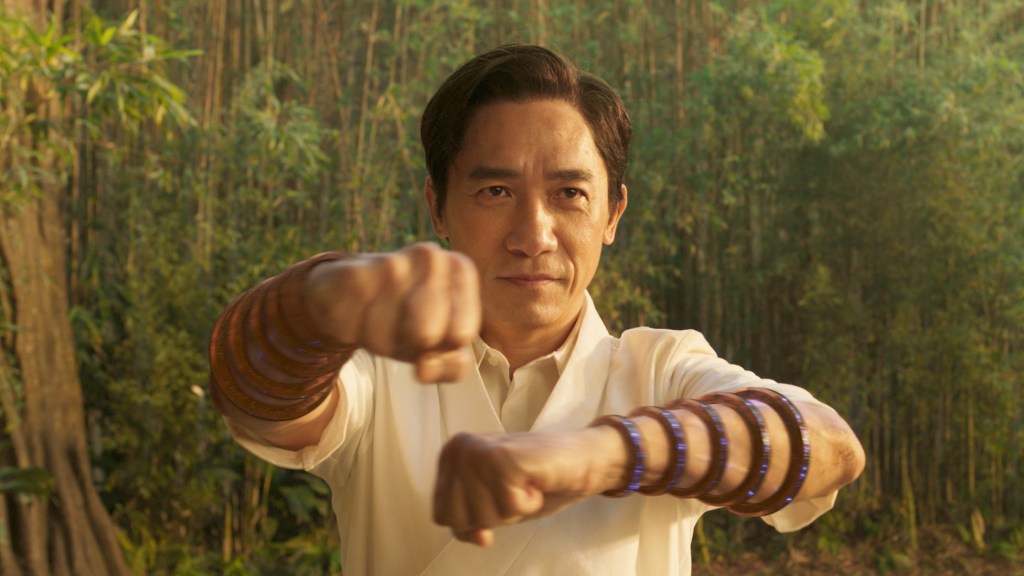
It stars an excellent Tony Leung as Xu Wenwu, a ruthless crime overlord briefly saved by love until that love is lost, wanting nothing more than to reunite with his wife and bring his family back together. The titular son is also in this movie, whose story presumably reflects how traditional Chinese view their expatriates: he escapes his family responsibilities by running to America, spending a decade doing menial tasks like valet parking and karaoke, only to be dragged back into the fold by Dad once the lost decade has passed and his lack of agency is assured.
Personal disappointments aside, this is not a bad movie. After the painfully expository first 15 minutes the action starts in earnest, and once you accept that there is no more characterization to be had you can just relax your brain and enjoy the ride: it’s a fun one, with some excellent fight sequences and choreography; some of the best in the MCU.
Where the problems arise is when this movie is used as an example of representation; after all the cheers for being the first Asian superhero movie and all the pride of finally having an international blockbuster starring Asian Americans, there is a relief and long exhale of perhaps having finally made it. We haven’t. There is more to representation than putting people of colour into films of wide appeal; representation is about the stories we choose to tell about the minorities we don’t often see in media: it’s about choosing stories they can see themselves reflected in, and where they can find validation. It’s about choosing stories that show us what’s possible beyond the stereotypes, beyond the boxes that have been placed around them. To show us worlds they didn’t know they were allowed to dream.
While not meeting this admittedly grand ambition, Shang-Chi could have still been a step in this direction while still fulfilling the obligations of the MCU. But by telling a story through a China-centric lens with Asian American characters, there is instead a reinforcement of the other box that we Asian Americans are often trapped in: that China is our patriarch, and that we, without agency, hidden in its long shadow, don’t have a story of our own outside of its point of view. To move from a lifetime of being invisible extras and bit players in American stories to being the lesser-than in a China-centric story is not progress: we have hustled sideways from one box into another. The original Shang-Chi of the 1970s comics was a racist portrayal of an Asian man, coloured an unnatural yellow without shoes or shirt, spouting fortune-cookie platitudes in stilted English. Today he is a man who is defined only by his father’s past, an unopinionated blank slate motivated only by circumstance, who does kung fu and rides a fucking dragon. How far have we really come?
 ian is blogging