The online tests tell me that I live on the line where introversion and extroversion meet, though my childhood tells me I grew up well within introversion country. Only over many years did I slowly walk my way over to the border. Speaking up, let alone in public, did not come naturally.
I recall these childhood moments clearly, as the accompanying stress was enough to sear them into my memory forever. The first time speaking to a stranger was ordering hamburger toppings at the local Harvey’s: my mother pushed me to do it, forcing me out from hiding behind her. The world seemingly froze as I enumerated sauces and vegetables before quickly retreating to safety back behind her legs.
Years later, I faced a microphone for the first time in what was to be a terrifying and profound failure. Having run for elementary school class treasurer for reasons I can no longer recall, I knew that a speech was part of the political process but was not prepared for what it would actually be like.
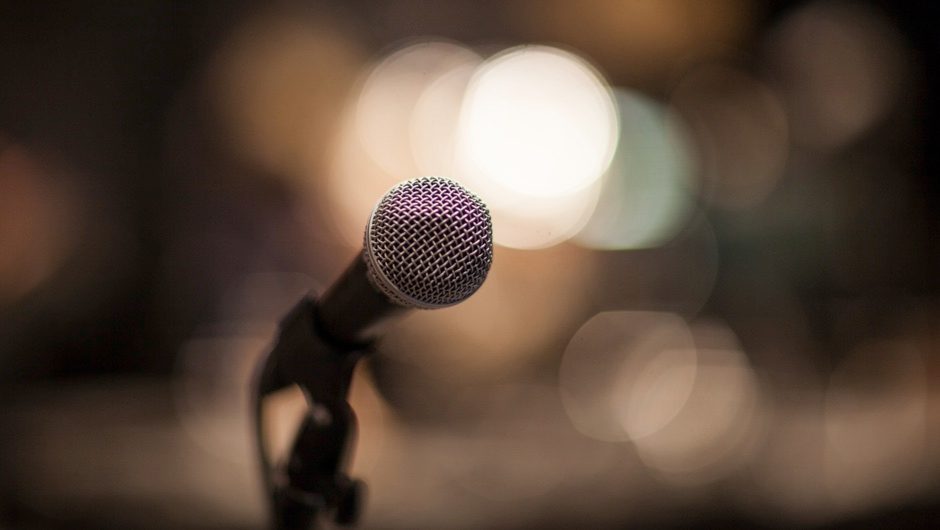
All focus was on the small silver microphone pointed accusingly at my face; every sound I made indiscriminately and ruthlessly amplified. My peers sat cross legged and impatient on the gymnasium floor, glaring up at me on the uncomfortably elevated stage. For someone who could barely speak up in class, this was terrifying. Reading off my speech from a shaky stack of cue cards, I still remember the confused and angry faces the few times I looked up into the audience. I finished to a disapproving silence, the sound of my own lack of confidence still reverberating loudly around the room. Needless to say I did not get the vote.
These memories resurfaced decades later, working my first real job after university: enthusiastic for my new corporate life at a large multinational technology company, I had joined a networking group. We were planning a social event dinner and needed an MC to run the evening for the 30-50 guests. As we basked in the tense silence that follows requests for volunteers, my old memories flashed back quickly before me, with all its amplified insecurities and resulting traumatic silence. Experts believe that negative public speaking experiences in childhood can leave children with a lifelong fear of the podium. I can see that. Still, I found myself compelled to raise my hand; something inside made me do it. Apparently it was time.
The event soon came, and something clicked. It seems some personal growth had occurred inadvertently in the decades following elementary school: years spent trying to be funny in class seems to have sharpened my reactive wit, and my post-pubescent voice, now too low to be heard in bars and restaurants, happened to work well on a microphone. The cheers and applause surprised me; I took an awkward bow, not knowing what else I was supposed to do. When the committee planned for future events I never had to raise my hand again. There was a job that was now mine by default.
Once my unmarried friends found out I had some event hosting experience, I inevitably became the de-facto wedding MC, and the events got larger and larger. Venue coordinators ask if I was a professional after watching me work, though I presume they say that politely to everybody. Friends have said that my interesting and engaging onstage presence is completely different than the me in real life, and they meant that as an honest compliment. Strangers in the audience have approached me with awkward praise before scurrying off to the dessert table. The DJ at a large Indian wedding I hosted told me he’d never seen this particular audience actually pay attention like this. It seems I can make a 300-strong crowd of Indian uncles and aunties listen to speeches and not immediately stampede the buffet, though I can barely hold focus telling stories at a small dinner party.
Through it all I still identify as an introvert, and looking back I found that it’s the naturally introverted traits which were actually the most useful when talking in front of an audience. To speak publicly is to be deeply focused on a task without distraction; the overall experience is less like speaking to other people than it is like speaking to yourself; you just happen to be doing so in front of those other people.
As such, the relationship between a speaker and a large audience is unlike most other human relationships. Something strange happens once a group size reaches a critical mass: the individuals in the audience stop being people altogether, and meld together into a new and separate entity. You can feel its essence permeate the air, in the chatter and indistinct murmurs between the clinking of the tableware. It is the feel of the room, the manifestation of its vibe, amorphous and ethereal; the psychic slurry of everybody’s individual feelings. All the people are essentially gone, shadows behind the blinding spotlight; there is only the communal spirit of the audience, a wilderness creature that you have to make your friend. And how do introverts make friends? By listening and feeling things out, and by being calm and not trying to dominate; these tactics that work well on animals also apply for taming large groups of people, given that they’re much the same thing.
All of these potentially wonderful experiences lie locked behind the fear of speaking itself. It takes some time to hear the sound of your own amplified voice without panic, let alone do the actual talking. Starting is the hardest part: the lead up to the first word into the mic is nothing but stomach knots and escalating tension, like a climbing roller coaster that’s getting ready to drop. Once the ride starts you acclimate quickly, but the lead-up has always been some kind of terrifying. Even now, after all this practice, the fear in the moments before speaking have been a constant throughout life: from bombing elementary school speeches to emceeing large events to raising my hand in class or running meetings at work, speaking up has always been preceded by anxiety and a touch of dread. With enough practice though, you figure it out. Introversion and extroversion are like muscles: if you’re born favouring one side you can still find ways to strengthen the other. Though the same fears have always been there, constant and reliable from the beginning, the weight of that anxiety has remained the same while carrying it around has gotten easier with exercise.
And now, here we are. I’m an introvert that loves public speaking. Interests include writing alone, thinking alone, sitting alone in a boat on a lake, and speaking alone in front of hundreds of people. Even though failure is a distinct and painful outcome with its boos and awkward coughing, never forget that success can also be possible, and that it can be wonderful. It’s a chance to touch many people’s lives all at once and feel their reaction in real time. For introverts, success can be even more meaningful; there is something special about talking effectively to an audience for people who don’t talk often. For the quiet ones in the back who all secretly have something worth showing and for the wallflowers that really just want to be seen, a lifetime of the deep and unshared can finally have an outlet: a room full of people, open to be influenced and who’s recognition is there to be earned.
But for me, for every time I do a microphone check and step up behind the podium, for every time the roller coaster starts and the anxiety comes to a head, I’m telling my past self in grade school after his disastrous speech that everything will be okay, that he did the right thing, and that even though it may be hard now it all worked out in the end. And whenever an evening ends with smiles, laughter and applause, that little boy is vindicated, each and every time.
 ian is blogging