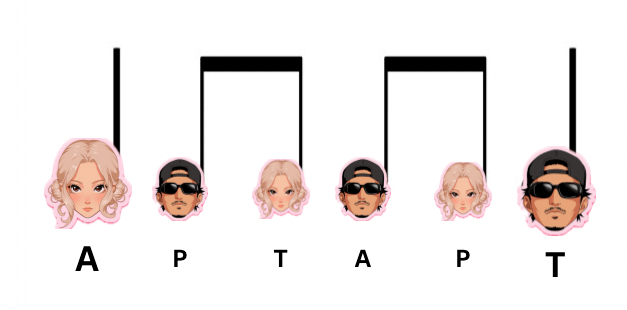
Rosé’s APT uses almost every chord in the scale

it’s probably in C minor and has every chord there except D minor, and other music theory facts that you probably don’t care about.

APT has a surprising amount of harmonic complexity for what is more or less a straight pop song. Which is fancy talk for saying it has unusual or interesting chord choices. This is going to get right into music theory land with no training wheels, and maybe some more specific production details, so If I haven’t lost you yet, I definitely will now! Here we go!

There are strong signals that this song is in Cm. The “uh huh uh huh” of the main cheerleader girl chant chorus are Bb to C, ie VII to I. The verse is the same, and the bridge is C, Bb, Eb, C (so I, VII, III, I), which also feels strongly locked to Cm, although that sequence itself is a little unique.

The pretty and melodic pre-chorus however is Ab, Bb, C, to Eb, and it’s still not clear to me if it’s in Cm or if it changes key to Eb. In Cm it’s consistent with the rest of the song but the relative chord combinations get awfully strange, because what the heck is VI, VII, I, III? Comparatively in Eb it presents as a much more normative IV, V, VI, I, but then why change keys just in the pre-chorus? 

Weird! 

But maybe ambiguity is the point. A good pop music strategy is to milk the tension before the catharsis, whether this is EDM drops or soft verses exploding into loud choruses or modern pop melodies that tease a resolution to the root that may or may not happen.

Given the key of the rest of the song, I think Cm makes the most sense. The idea of VI escalating stepwise upwards to I but then ending on III (which is kind of a flakier version of I anyways) and then cycling back to VI and going on forever kind of tracks – like the way most pop songs melodies today, forever sitting on II and never resolving to I or III, are in constant state of deliciously, tense limbo.

Moving to the bridge, we still have some interesting things to discuss.  The build-up guitar-style chug into the bridge is on G, which as the V of C makes complete sense, but is notable as the first we’re hearing the chord in the song. It resolves to the I, VII, III, I of the bridge, (C, Bb, Eb, C), which as noted is already an unusual combination, that then ends with a repeated hammering on F.  

F!  Where did F come from? 

Although as the IV of C it is harmonically quite unremarkable, but for it to show up now, for the first time, with the song being almost over, in such a forceful and climatically manner it kind of blew me away. 

The song has now featured every chord from I to VIII except for II. No supertonic for you. Take that, The Weeknd.

And just as this feels like a peak, it steps upwards even higher from IV to V to VI, running right through a pseudo-deceptive-cadence into the prechorus, which in itself is escalating stepwise upwards from VI to VIII. The song’s constant continuous escalation going into its climax is underpinned by these harmonic choices, chord structures, and application of music theory.

All in the service of good pop music. Pop music! Not classical, prog, experimental, indie or dance, but pure pop – the simplest, catchiest, and most digestible form of music, made with the explicit purpose to be understood and enjoyed by as many people as possible. For a pure pop song to have any complexity or nuance, whether in construction or music theory or cultural context, is to me that much more meaningful, as all the complexity must be refined to the point where it still appears simple on the surface. 

And that’s it. After spewing out over 3000 words into the ether I have finally run out of things to say about this 3-minute K-Pop trifle. But to the song’s credit, over the month-long rollout of these essays my initial blast of enthusiasm has waned only slightly.


If you’ve made it here to the end, thank you for sticking around. And if you like what you read, join my mailing list and never miss an update:

Processing…
Success! You're on the list.

Rosé’s APT is smarter than you are.

K-Pop single impresses cynical 40-plus year old man

Rosé, from K-Pop supergroup BLACKPINK, has released a hit song in collaboration with Bruno Mars, and it is both excellent and fascinating on multiple levels.

It may even be smarter than you are, who knows, I needed a headline. Here we go.

The Basics

For starters, it gets a lot of the basics right. Every part of the song is a hook, from the titular chorus, (the “oh Ricky you’re so fine” cheerleader-girl-chant,) to the amazing melodic pre-chorus (“don’t you want me like I want you baby”,) to the bridge (“hold on, hold on, i’m on my waaay”,) to even the verses, each section is so catchy such that It almost doesn’t matter what order you put them in. 

Be a Great Vocalist

It also turns out that Rosé is a great vocalist. She has enough attitude to carry and own the chorus and her rap verses, but more importantly her singing is great: clear, strong and expressive. 

Her singing carries the bridge, and owning the bridge is critical as it’s in itself a huge build that relies heavily on having a strong vocalist. The Open-“A” sound she gets when she sings “way”, through whatever tube-amp-Vintage-Rock vocal processing they have setup for her, makes her sound good in a way that’s like Bethany Cosentino from Best Coast.  And that’s very good. This song wouldn’t have worked without that level of vocal talent.

Partner with a Complementary Great Vocalist

Getting Bruno Mars to somehow be on your track was already such a great pull both from a songwriting and performance standpoint, it’s almost unfair that on top of all that, he’s a great vocal match for Rosé: expressive and confident but in a different register. 

They are so dialed-in when they harmonize on the track (which they thankfully do a lot of), executing the same vocal performance and expressions but with complementary timbres. The chills I got listening to them only wore off after the first few dozen times replaying the song and bopping like a maniac. 

With a foundation this strong success is almost guaranteed, but then it goes and does a few more things on top that take it to the next level but are also more interesting to talk about.

Song Construction

Continuous Escalation

Good thrillers and action movies will ratchet up the tension and excitement at every moment, and this song does something similar. Though it follows your classic pop song construct, repeating choruses with pre-choruses, verses and a bridge, none of the repeated sections are ever exactly the same. Each new repeat adds a new element that elevates the song meaningfully, whether it’s switching vocalists on each verse or adding harmonies on the second pre-chorus. It just constantly builds and builds and builds. Especially the chorus.

Each of the four choruses (the “ah-pu-tu” chant of the title) gets progressively richer harmonic accompaniment – which is fancy talk for supporting chord structures. The first chorus of the intro is just the chant, a capella with the beat. The second one adds the chord progression of the verses, a basic I and VII in C minor. By the time we reach the third, we are now resting on the chord progression of the sung pre-chorus, a pretty and uplifting Ab, Bb, C, to Eb, with the fourth iteration adding full blown maximalist vocal harmonies for climactic effect. Hooks or riffs that start with minimal chord changes or tonality that then flip to really rich chord progressions is one of my favorite things.

Genre Flip in Act 3

For the first two-thirds of its runtime, APT is a Pop song. There is the catchy chant of a hook, meaty synth anchors, and a beat that sounds like it might be from a real kit, bouncy and full of handclaps. Like the comparable beat of Shake it Off, this is a Pop song with cheerleader and drum line energy.  For now.

It’s not until the bridge that the track fully flips into an Indie-Pop-Punk thing, adding a series of strong Rock & Roll signifiers: The kit drums start to rock out on open hi-hats, Rosé does her tube-amped Garage Rock yell, and the dirty synths start to function as distorted guitars – complete with a simulated guitar-chugging build at the beginning of the bridge, something I don’t think I’ve heard done before. 

Though naturalistic cheerleader-chants and live drums parse as Pop on their own, they also serve as a good foundation for pure Rock & Roll when these other pieces from the bridge are layered on top, shifting the song’s direction without feeling abrupt or a clash of conflicting styles.  It’s simple, but really really smart. 

This genre change is a key step in the continuous escalation of the song, kicking things up a notch going into the bridge – which is in itself a giant Rock build into a climactic refrain of the pre-chorus, a classic breakdown over start/stop live drums, peaking and ending with the final chorus, with the full and glorious backing harmonies on top. Good songcraft and continuous escalation.

What a rush. For me, anyways. Not sure how you feel about it, but if you want to see how there are three more essays worth of material on this seemingly benign k-Pop trifle then feel free to keep going to Part 2 right here or join my mailing list to keep updated.

Processing…
Success! You're on the list.