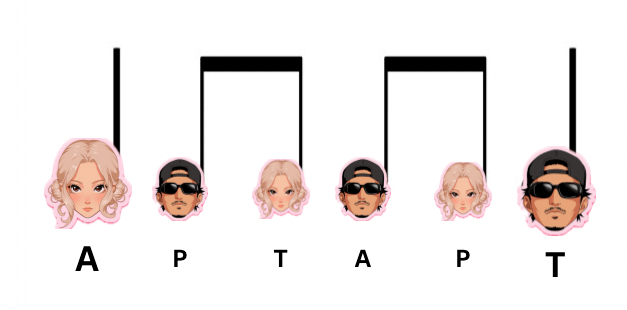
Rosé’s APT uses almost every chord in the scale

it’s probably in C minor and has every chord there except D minor, and other music theory facts that you probably don’t care about.

APT has a surprising amount of harmonic complexity for what is more or less a straight pop song. Which is fancy talk for saying it has unusual or interesting chord choices. This is going to get right into music theory land with no training wheels, and maybe some more specific production details, so If I haven’t lost you yet, I definitely will now! Here we go!

There are strong signals that this song is in Cm. The “uh huh uh huh” of the main cheerleader girl chant chorus are Bb to C, ie VII to I. The verse is the same, and the bridge is C, Bb, Eb, C (so I, VII, III, I), which also feels strongly locked to Cm, although that sequence itself is a little unique.

The pretty and melodic pre-chorus however is Ab, Bb, C, to Eb, and it’s still not clear to me if it’s in Cm or if it changes key to Eb. In Cm it’s consistent with the rest of the song but the relative chord combinations get awfully strange, because what the heck is VI, VII, I, III? Comparatively in Eb it presents as a much more normative IV, V, VI, I, but then why change keys just in the pre-chorus? 

Weird! 

But maybe ambiguity is the point. A good pop music strategy is to milk the tension before the catharsis, whether this is EDM drops or soft verses exploding into loud choruses or modern pop melodies that tease a resolution to the root that may or may not happen.

Given the key of the rest of the song, I think Cm makes the most sense. The idea of VI escalating stepwise upwards to I but then ending on III (which is kind of a flakier version of I anyways) and then cycling back to VI and going on forever kind of tracks – like the way most pop songs melodies today, forever sitting on II and never resolving to I or III, are in constant state of deliciously, tense limbo.

Moving to the bridge, we still have some interesting things to discuss.  The build-up guitar-style chug into the bridge is on G, which as the V of C makes complete sense, but is notable as the first we’re hearing the chord in the song. It resolves to the I, VII, III, I of the bridge, (C, Bb, Eb, C), which as noted is already an unusual combination, that then ends with a repeated hammering on F.  

F!  Where did F come from? 

Although as the IV of C it is harmonically quite unremarkable, but for it to show up now, for the first time, with the song being almost over, in such a forceful and climatically manner it kind of blew me away. 

The song has now featured every chord from I to VIII except for II. No supertonic for you. Take that, The Weeknd.

And just as this feels like a peak, it steps upwards even higher from IV to V to VI, running right through a pseudo-deceptive-cadence into the prechorus, which in itself is escalating stepwise upwards from VI to VIII. The song’s constant continuous escalation going into its climax is underpinned by these harmonic choices, chord structures, and application of music theory.

All in the service of good pop music. Pop music! Not classical, prog, experimental, indie or dance, but pure pop – the simplest, catchiest, and most digestible form of music, made with the explicit purpose to be understood and enjoyed by as many people as possible. For a pure pop song to have any complexity or nuance, whether in construction or music theory or cultural context, is to me that much more meaningful, as all the complexity must be refined to the point where it still appears simple on the surface. 

And that’s it. After spewing out over 3000 words into the ether I have finally run out of things to say about this 3-minute K-Pop trifle. But to the song’s credit, over the month-long rollout of these essays my initial blast of enthusiasm has waned only slightly.


If you’ve made it here to the end, thank you for sticking around. And if you like what you read, join my mailing list and never miss an update:

Processing…
Success! You're on the list.

Whose Song Is It Anyways (feat. Bruno Mars, Rosé & Lady Gaga)

Dammit Bruno, stop helping people, it’s confusing.

“ROSÉ & Bruno Mars – APT”

Though the international smash hit APT feels like it has been released as a Rosé solo track, if you look more closely it gets more complicated. 

On YouTube and streaming services, the song is labeled as “Rosé & Bruno Mars – APT.  Though Rosé is listed first, Bruno is positioned as an almost equal partner. It is not “Rosé – APT (feat. Bruno Mars)”, like in solo songs where another artist just kind of shows up for a verse. 

In the song’s artwork, ROSÉ is shown in big bold font, with Bruno Mars in a smaller font. Their names are separated by a stylized lightning bolt. If they wanted to put an ampersand, they would have put an ampersand. All this keeps their collaborative partnership even more vague.

It is definitely led by Rosé. But by how much?

Rosé has talked about how she came up with the “APT” hook, based on the Korean drinking game. That hook is definitely hers, and is distinctly Korean. But I suspect the rest of the song was heavily influenced by Bruno Mars. Something about the way he sings the pre-chorus feels like it was made for and by him, he has some history with a rock aesthetic, and some of the more atypical chord progressions do map to things he’s done in the past. Rosé has none of this stylistic breadth or complexity in her comparatively short history, nor in the songs she’s released since.

Obviously I have no proof of any of this and the full list of songwriting credits is quite long, so it’s hard to know who did what. But if, for the sake of the exercise, we just assume that I’m right, one could argue this is as much or more of a Bruno Mars song than it is a Rosé song. She doesn’t even sing lead on the pre-choruses once they start harmonizing.

So why does it still feel like it’s hers? 

Though the marketing of the song simply as being Rosé-first definitely helps, there is something else happening here in how the song itself is presented.

And that is, quite simply, that Rosé goes first. 

The first thing you hear is the chorus, which she sings. Then she does the verse and pre-chorus. She does them first.

The first time you experience each section of the song, it is her voice you are hearing, so subconsciously each section of the song is then anchored with her. 

By the time Bruno Mars appears, even though some of the connections with him may be deeper and firmer it’s really hard to shake the ideas of ownership we already have.  

Showing up first counts for a lot.

Imagine if it didn’t open with the chorus. What if Bruno’s verse and pre-chorus came first, even if Rosé kept the chorus and the bridge.  Would it still feel like her song? Or is she now a feature on a Bruno track, with a slightly Korean flavour?  

If only there was another comparable Bruno Mars collaboration that almost does this exact opposite thing. 

“Lady Gaga, Bruno Mars – Die with a Smile”

Just two months before APT dropped, “Die with a Smile” was released, a Bruno Mars collaboration with Lady Gaga. On YouTube and Streaming Services, the artist is labeled as either “Lady Gaga, Bruno Mars” or “Lady Gaga & Bruno Mars”. The music video is on Lady Gaga’s YouTube page, while Bruno hosts a live performance with 5% of the views. Clicking the Artist link on a music streaming services takes you to Lady Gaga’s page, not Bruno’s. 

The artwork on the single shows the two artists standing together, artfully, roughly right next to each other with equal positioning – except that Lady Gaga on the left has her arm and shoulder ever so slightly ahead of Bruno Mars. 

All of this positioning points again to a mostly equal partnership, with the artist that is not Bruno Mars being slightly in front.

When I actually listen to the song though, I completely forget that Lady Gaga is even in there at all. It’s always a surprise when she starts to sing, and when the song ends I’ve forgotten she exists again. To me, this is a loosie Bruno Mars single, steeped in his songwriting and melodic style even from the opening strumming pattern. When they say this was written collaboratively based on an initial idea from Mars, it feels to me like that initial idea was pretty well formed from the jump. Lady Gaga has almost zero presence.

Though this is all once again purely subjective (and depending on your Lady Gaga fandom a potentially unforgivable sin), I do have the one supporting fact in my favor: that Bruno Mars goes first. He basically gets the entire first minute and twenty-five seconds to himself.  The first time you hear each section of the song, it is with Bruno Mars’ voice. The verse, the pre-chorus, and the chorus, he took them and anchored them all. Not counting some subdued backing vocals, Lady Gaga doesn’t even really show up until 34% of the song is over.

What if their roles were reversed? What if Lady Gaga went first, and was the one introducing you to each section of the song? Would it have made a difference? It would have for me. Maybe for you too.  But we’ll never know.  Because you only have one chance to make a first impression and anchor an idea with an audience. There is only one chance to go first – and in this universe, Bruno took this song and Rose took the other, and our impressions from that point onwards are going to be what they are.

Going first matters.

So why don’t you join my mailing list so you can be the first to experience whatever comes next?  See what I did there? I am very good at this. See you soon.

Processing…
Success! You're on the list.