“Everything Everywhere All at Once” and the Perfect Immigrant Super-Mom

Won’t you be my mommy?

[This is a follow-up piece to a previous essay about “Turning Red”, which I recommend you read first.]

On its face, pairing and comparing “Everything Everywhere all at Once” with “Turning Red” makes not a lot of sense. Yes, they are both popular movies, released in the same year, deeply focused on the Asian-American experience, and thematically aligned from tip to tail. But one is a martial arts multiverse action movie, while the other is a fluffy coming of age animated adventure. And while you may wonder how these two seemingly parallel lines intersect, I’m here thinking they are in conversation with each other, not just thematically but literally as well. Stay with me, I’m probably into something. Spoilers to naturally follow.

“Everything Everywhere all at Once” is, as its title suggests, about many things. The Chinese immigrant Evelyn, our protagonist, is trying to simultaneously be a mother, wife, and daughter as well as laundromat co-owner and operator, which means she is doing none of these things successfully. She is fractured, and the entire multiverse conceit itself is an expression of the shattered nature of her being, the amped up version of her key character flaw. Her daughter Joy, born and raised in modern America, represents the Millennial Asian-American. She too is fractured, but in the way a generation raised on the internet would be, with everything available all at once, on demand, on your phone. When all information is at your fingertips always, then everything is equally loud, which makes everything equally important. And when everything is important, then nothing is. Nihilism, as well as existentialism, kindness and family are all key themes in the movie. But at its heart is a story of what a mother will do to be with her daughter after realizing just how far away they are from each other.

It takes a while for this arc to start and for Evelyn to come into her own, as the first half of the film is spent on equal parts exposition and reacting to threats: we learn how the world and the rules of the multiverse work, while the heroes run from bad guys and hide under tables. It is at the midpoint where Evelyn finally demonstrates agency and makes her first choice: to not kill her daughter with a boxcutter. A most basic parenting decision in normal circumstances here marks the beginning of Evelyn’s journey: the declaration that the single life of her daughter is more important than the safety of an entire multiverse.

For the rest of the movie, Evelyn puts herself through the same traumas as her daughter just so she can understand her and meet her where she is, peering over the edge of the nihilistic abyss with her together. She then puts herself through her own personal growth journey, evolving herself first so she can then heal her daughter, step her back from the edge of darkness, and resolve all her other familial conflicts along the way. This is peak parenting; heroic levels of motherhood.

Contrast this with the end of Turning Red, where the daughter expresses her fears of losing her relationship with her mother: although she knows who she wants to be, she is scared that it will cause them to drift apart.  Though Meilin’s mother apologizes and admits to sharing the same fear, the dramatic question remains largely unanswered: the burden is on Meilin to grapple with the potential cost of her self actualisation, and though the movie ends with the Westernized Asian choosing herself, she is left wondering if she made the right decision.

It is Evelyn’s arc that provides an answer: she develops both the desire to be with her daughter wherever she may be, as well as the abilities needed to cross any distance, whether cultural, emotional, metaphysical or otherwise, to meet with her where she is. Evelyn’s story is a response to Mei Lin’s fears: it tells us that we can find our own path without fear of widening a generational gap with a parent, because the parent will take on the burden and the work of closing that gap.

Except, of course, that Evelyn does not exist. While Turning Red is a fantastical but still autobiographical story about growing up as a Westernized Asian, Everything Everywhere All at Once is an Asian-American fantasy about the perfect mother: Evelyn is the platonic ideal of the immigrant parent, imagined by the modern Millennial and Asian-American creators who are themselves reflected in Joy, the daughter. A perfect immigrant Super-Mom only exists in fiction. 

The reality for immigrant families is that bridging both generational and cultural differences is messy. Even when there is both a recognition of the distance and the desire to bridge that gap, many don’t have the self awareness or the emotional tools or facilities to do so.  When acts of love in one generation’s culture are interpreted by the other as acts of control, our lives are spent inadvertently pushing each other’s buttons when all we’re trying to do is show each other that we care. 

It’s hard, as Westernized children of immigrants know: “For some reason when I’m with you it just hurts the both of us”, Joy tells her mother in the laundromat parking lot.  But even as each act of care is culturally misinterpreted, we all still try, because we all still love each other. 

And so, armed with all the wrong tools, the parents flail lovingly in the general direction of their children, and the children flail lovingly right back at them, and all hope that some of the lines thrown across the chasm will connect. And though most of them will miss or be misunderstood and cause more pain instead of relief, we do it anyway and push through the stress, because in the end we love each other and we’re the only family we’ve got. But in the few fleeting moments when the stars align and the mood is right, a line that is thrown is caught and a real connection is made and we can, for a brief moment, see into each other’s hearts. And that glimpse can sometimes fill us up just enough to make it through the next chaotic cycle, in the hopes that one day we figure out a way to make it work with the broken tools that we already have. 

Because even in a stupid, stupid, universe where you have hot dogs for fingers, you get really good at using your feet.


If you’ve made it here to the end, thank you for sticking around. And if you like what you read, join my mailing list and never miss an update:

Processing…
Success! You're on the list.

“Turning Red” and the Asian-American experience

Scary, I know.

It’s such a joy to see not one but two popular movies released in the same year that not only feature Asian-Americans, but accurately portray aspects of the experience as a core part of the story and its themes. I think that they speak to two sides of the same conversation, and that they both happened upon the same core theme shows how important and formative this conversation is to the community. Turning Red, the first film of the two, explores the idea from the point of view of the child of immigrants: it’s the Asian-American experience. Spoilers to naturally follow.

From the ancestral lore as told to Meilin from her mother, their family has the ability to harness emotions to transform into a powerful mystical beast: any strong emotion will release your inner Red Panda. But when their family decided to “come to a new world”, what was once a blessing became an inconvenience. 

If “strong emotions” turns you into a Red Panda, then it is basically an expression of your inner primal self, all weird and animalistic, socially unacceptable and unique, as every family member manifests their red panda differently. In essence, it’s your id on display. That this comes up around puberty makes a ton of sense.

In Chinese and other Eastern cultures, individualism is traditionally frowned upon, or at the very least not valued highly. Family comes first: respecting and caring for your elders, keeping familial bonds tight, securing the future of your children, and all the discipline that this would demand. After all that, there isn’t much time left for self-exploration. Anything that doesn’t fit or contribute to the other priorities becomes a problem. Or an inconvenience, perhaps.

This is explicit in the first two minutes of the film which both summarizes the entire movie and explains Meilin’s family, the world and values of her mother and the generations before them. And coming from this world, the most effective solution to resolve the Red Panda problem, the unpresentable parts of your self, is to excise them completely. Simply suppressing your unwanted feelings into a tight explosive ball is amateurish compared to ritualistically cutting them out and trapping them into breakable lockets.  Pencil me in for the next lunar eclipse.

For Meilin however, raised in a culture that prioritizes self-actualization with a peer group that loves her unconditionally, (“panda or no panda” she imagines them saying,) her eventual solution is to synthesize her disparate parts into a cohesive, psychologically healthy and occasionally fluffy whole. That by the end of the movie her family believes and trusts in her enough to let her make her own decision is by itself already wonderful, but what elevates this movie is the cost of this decision, and the moment of doubt that it casts. 

Because at the end, Meilin says to her mother: “I’m finally figuring out who I am.  But I’m scared it’ll take me away from you.”  And then I want to cry a little. 

This moment is not just the crux of the story, but of the Asian-American experience, immersed in a culture since birth that is at times diametrically opposite to the one of your family. It means in your life you will need to make choices, consciously or not, about which culture’s values you want to believe and invest in, with each choice implicitly meaning the rejection of the other culture not chosen.

Whether opening your mind to today’s progressive ideas or just focusing on better understanding yourself, a decision to embrace modernity will erode the relationship with a more conservative family if they are not on the same journey with you. And a decision to embrace tradition and history and the culture of your roots may come at the price of weaker integration with society, and all the opportunity costs that would entail: new ideas, friendships, romances, and careers; never had, and never envisioned.

This is a universal truth I’m sure, to many children of immigrants anywhere, or any other expression of a wide intergenerational gap. That every day we all make choices, some tiny and some large, and that they all come with a cost, and over time all these different sized choices will add up to the Story of You: both the one you are and the one you are not, the mirror counterfactual self that you could have been but chose not to be. In the compromise that is life, many paths are beautiful, and though there is no wrong answer you can only have one. You have to choose. And every choice has a cost.

At the end of the movie, after the ceremonies are complete and Meilin has made her choice and all is said and done, she says “I’m not going to regret this, am I?” To which the Red Panda Goddess thing smiles and swoops her up for a joyous ride. The movie ends with a montage of her new balanced and furrier life, all of which implies that Meilin made the right decision. But it is telling that the question is explicitly left unanswered; only time will tell if that decision was worth the cost of a mother and daughter drifting apart. And that is a question that maybe only Meilin can answer.

[This essay is the first in a two-part series, concluding with this piece here on Everything Everywhere All at Once]

Shang Chi is an appeal to China masquerading as representation

It is quite literally not for me

My hope had always been that this movie would be an allegory for the Asian American experience.  With an Americanized son at odds with his traditional Chinese warlord of a father, it wouldn’t be too big of a stretch to work in some themes that might have had some resonance.

In the film, Shang-Chi rejects his family dynasty, not ruthless enough to fit into that culture, and escapes to America.  We could have seen him struggle trying to fit into the Western world, hiding his heritage and who he really is. He could have spent the movie navigating this cultural purgatory, not fully belonging in either place, and as he fights his way through the plot realize that he can decide for himself what his own values are and who he wants to be, living with a foot in each world when they aren’t busy kicking people. By the end he would have achieved synthesis between his family’s culture and his new American life. It could have been the aspirational life story of the second generation immigrant. Something like that, anyways.

But that’s not what we got here. And that’s ok. After all, walking into a movie with a mind full of headcanon is a recipe for disappointment: it’s not fair to critique a thing for not being what you expected. It is a Marvel movie after all, and being an entry in a multi-billion dollar global franchise means being subject to other obligations. 

There is no compelling business case for tailoring a blockbuster to an Asian American audience, especially when doing so would put it at odds with China, the world’s largest market for film. They may not appreciate a story where an Asian protagonist surpasses his traditional Chinese father by embracing his own Americanism. That the movie has yet to be allowed a release in China does not blunt its intentions; it only reminds us of who’s calling the shots. 

And so we have this: Shang-Chi and the Legend of the Ten Rings, created as a modern day Chinese Kung-Fu movie to maximize its palatability to its true target audience. Simu Liu, Awkwafina and the Marvel brand figure largely on the packaging in order to keep its appeal to American shoppers, like wheeling a Trojan horse through U.S customs.

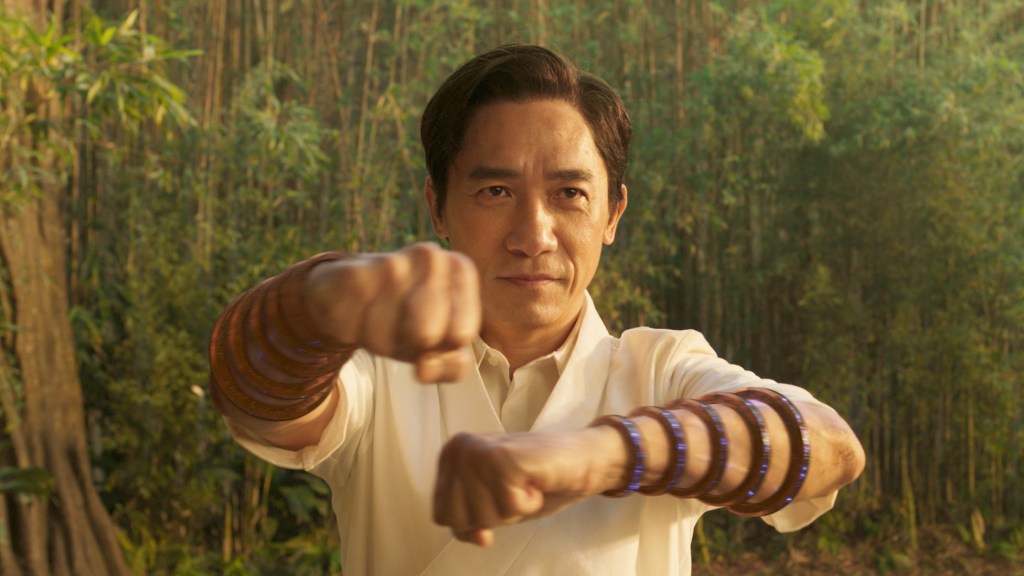
It stars an excellent Tony Leung as Xu Wenwu, a ruthless crime overlord briefly saved by love until that love is lost, wanting nothing more than to reunite with his wife and bring his family back together. The titular son is also in this movie, whose story presumably reflects how traditional Chinese view their expatriates: he escapes his family responsibilities by running to America, spending a decade doing menial tasks like valet parking and karaoke, only to be dragged back into the fold by Dad once the lost decade has passed and his lack of agency is assured.

Personal disappointments aside, this is not a bad movie. After the painfully expository first 15 minutes the action starts in earnest, and once you accept that there is no more characterization to be had you can just relax your brain and enjoy the ride: it’s a fun one, with some excellent fight sequences and choreography; some of the best in the MCU.

Where the problems arise is when this movie is used as an example of representation; after all the cheers for being the first Asian superhero movie and all the pride of finally having an international blockbuster starring Asian Americans, there is a relief and long exhale of perhaps having finally made it.  We haven’t. There is more to representation than putting people of colour into films of wide appeal; representation is about the stories we choose to tell about the minorities we don’t often see in media: it’s about choosing stories they can see themselves reflected in, and where they can find validation.  It’s about choosing stories that show us what’s possible beyond the stereotypes, beyond the boxes that have been placed around them. To show us worlds they didn’t know they were allowed to dream.  

While not meeting this admittedly grand ambition, Shang-Chi could have still been a step in this direction while still fulfilling the obligations of the MCU. But by telling a story through a China-centric lens with Asian American characters, there is instead a reinforcement of the other box that we Asian Americans are often trapped in: that China is our patriarch, and that we, without agency, hidden in its long shadow, don’t have a story of our own outside of its point of view.  To move from a lifetime of being invisible extras and bit players in American stories to being the lesser-than in a China-centric story is not progress: we have hustled sideways from one box into another.  The original Shang-Chi of the 1970s comics was a racist portrayal of an Asian man, coloured an unnatural yellow without shoes or shirt, spouting fortune-cookie platitudes in stilted English.  Today he is a man who is defined only by his father’s past, an unopinionated blank slate motivated only by circumstance, who does kung fu and rides a fucking dragon. How far have we really come?